



Relating the Ancient Vedic To Ascension, Dimensions, Extraterrestrials, And More!

by Vinita,
Guest Writer, In5D.com
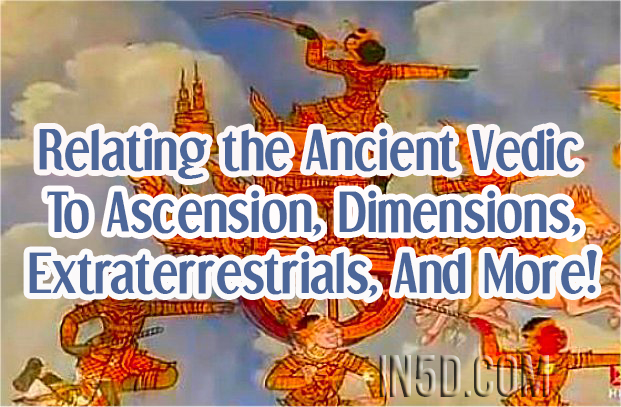
Ascension, dimensions, beings, UFOs, have always existed, and the ancient Vedic civilization considered itself part of a greater universal family. The Veds and Purans have extensive descriptions of star races, space ships, ascended masters, and so on; but in Vedic terms.
Donate to In5D
With over 6,000+ free articles and 1,200+ free videos, any donation would be greatly appreciated!
Much love for your kind donation,
Gregg
In this age we read spiritual terms in English and in ancient traditions the language and terms, though different, refer to the same things.
When we are able to find the relationship between definitions then suddenly we realize a lot of commonalities between the ancient, the new, the scientific and the spiritual. It somehow confirms that it must be the truth if so many for so long are saying the same thing.
Now we hear the terms, ‘Ascension’, ‘Dimensions’, ‘Beings’, ‘Extra Terrestrials’, ‘Soul’, ‘Consciousness’, and so on.
In Vedic terminology, ‘Lokhs’ relates to ‘Dimensions’.
‘Beings’ and ‘Extra-terrestrials’ relate to the different classes of beings mentioned in the Veds and Purans, .
There are fourteen Lokhs. Seven lower or descending Lokhs exist below the physical universe. The higher seven Lokhs are:
- Bhu’ – the physical 3 dimensional universe.
- ‘Bhuvar’ – that includes the souls that have passed on and relates to the 4th dimension;
- ‘Svah’ or ‘Dev’ Lokh where the Devas and some Rishis reside. These Devi-Devatas (dieties) are beings of light. ‘Dev’ means the luminous one, or one who illumines. This Lokh broadly relates to the 5th dimension.
These are the 3 Lokhs in which most souls recycle from birth to death to birth again, or the cycle of ‘Samsara’.
Then there is ‘Maha’ (6th dimension), ‘Jana’ (7th dimension), ‘Tapa’ (8th dimension), and highest ‘Brahma/Satya’ Lokh (9th dimension). All these are part of creation, or greater reality. What we see as the physical universe is only the 3 dimensional reality or ‘Bhu’ lokh.
All these Lokhs are still in the sphere of creation, duality, or Maya. It is beyond this that is Brahman, the Ultimate Supreme Consciousness. Time slows down and space expands as we move into higher Lokhs or dimensions. These are not physical but subtle realms.
Devas – Light beings
The ‘extra-terrestrials’ and ‘beings’ we read about relate to the many subtle forms of beings that are mentioned in the Vedic texts. These include the Devas, Asuras, Rishis, Siddhas, Kinnars, Yakshas, Gandharvas, Manas putras, Prajapatis, Kumaras, Avatars, and so on. In addition to these subtle forms there may be physical forms of beings on other planets, like humans, described in these texts. We don’t talk about it now in the Kali Yuga, but prior to the Kali Yuga other beings, dimensions, higher states of consciousness and special abilities such as telepathy, clairvoyance, were common and normal.
Sananda, Sanat Kumar, Sanak, and Sanatan
Our ancient texts talk about mind born sons (Manas Putras), or subtle thought forms, of Brahma (the creator diety). Four of these are the Kumars, they never age. Their names are Sanat Kumar (who manifests as Maha-avatar Babaji), Sanandan (the oversoul of Jesus), Sanak, and Sanatan, These mind born sons of Brahma also include the 7 original Rishis, also called Prajapatis, the creator beings. These were not physical forms but thought forms. These beings last as long as creation lasts. Then there are beings which are light forms, Devas. Many of these beings (including Rishis), came to earth and started the human civilization or mingled with humans for progeny. These stories are in the Purans, and Itihaas (epics) such as Mahabharat. Some physical forms were also organically growing here. A lot of these Rishis, Devatas, Siddhas, Avatars, etc., are also capable of taking physical form, i.e., descent from higher dimensions into the 3D earth dimension. That’s why the Rishis and people of ancient civilizations were so advanced in their knowledge. They were far more evolved beings which descended here on Earth and built advanced communities and cultures. Some of the remnants of this ancient civilization and knowledge can be found in the Vedas, and other Vedic texts.
Avatars
We are familiar with the blue skinned Avatars, Sri Ram and Sri Krishn. They were actually blue skinned and the texture was like that of the dolphins. Avatars are one of the highest evolved beings in the Vedic tradition, higher than Devatas. The Vedic texts also talk about several Nakshatras, the main star of a constellation. There are 27 main Nakshatras, and one more, Abhijit, which is the star Vega. In the Gita, Sri Krishn says that among the Nakshatras I am Abhijit, as he was from Vega. Rudra, the Vedic deity of transformation, is associated with Ardra Nakshatra which is the star Betelgeuse, of the Orion constellation. The origins of the Indian race was seeded by beings from Vega and Sirius, and perhaps many others including Orion. The 7 Rishis are the 7 stars of Ursa Major. Subtle light beings were from those stars.
Kali Yuga to Satya Yuga
The Vedic texts mention the gradual decline in civilization through the ages, called Yugas, this relates to the decline in knowledge, Dharma (natural law), dropping from higher states of consciousness, removal of the light aspect. We are presently in the age of darkness (or ignorance), the Kali Yuga. In this Yuga we are as though in deep slumber, the light has been shut out and because of the lack of light, dark forces are more dominant, such as anger, hatred, greed, and other negative emotions.
Many of us are reincarnations of those same highly evolved beings of the ancient world, the Rishis, Siddhas, Devatas, Avatars and other evolved beings. We have completely forgotten our true nature, we have lost our true history, so we think we are inferior beings struggling with darkness. Now we pray to Gods such as Sri Krishn and Sri Ram, and worship the Rishis and Devatas as though they are separate from us. When consciousness awakens in us, and we remember our true nature, that becomes the Avatar consciousness in us, or the Christ consciousness in us. We will remember our history and our connection with the greater universe, as one. There will be unity of consciousness among all beings. That consciousness within us is subtle light, it is a higher vibration than the lower vibration of matter. Like the difference between water vapor and ice. So when this realization and awakening happens in us, there will only be light and no darkness. This is like remembering, and going back to what we really are. This is the return of the Satya Yuga, the age of truth and purity, as the Yugas are circular.
The new age material talks about the coming of…a new age! This would be assisted by certain galactic waves of high vibrational energy. At the present time a lot of people will evolve to the 4th dimension and become more spiritual. Many are already in the 4th dimension/density prior to this ‘shift’ into the new age. You will read a lot about ‘Ascension’, referring to the evolution of a small percentage of people from the 4th dimension, carbon based body, into the 5th dimension, becoming a ‘being of light’. The carbon atom becoming a silicon (crystal) atom. Carbon conducts electromagnetic energy, and silicon crystals conduct light. The Deva Rupa or light being form is of the Svah/Dev Lokh.
New age masters also talk about Gaia (earth) transitioning from the 3rd dimension to the 4th dimension.
Moksha and Ascension
The concept of “Moksha” is liberation from cycle of birth and death, transcending duality into a realization of Oneness, and merging back to Brahman (eternal universal consciousness).
The ascension spiral is the evolutionary path of a soul through the various dimensions back to the Source. Ascension at the current time means evolving to the 5th dimension, spirituality and physically, as discussed earlier. This means going beyond the cycle of birth and death, realization of Oneness, and in terms of physical enlightenment, having an immortal light body. There are many variations this basic core new age message.
Knowing the structure of creation is good, however; the main thing to realize is that Oneness, we are the Ultimate Supreme Consciousness, Brahman. There is only One. That One is both immanent and transcendental at the same time.
We live in exciting times. Let see where destiny is leading us!
It’s a beautiful endless journey in eternity and infinity. We are like one spec of a fractal, an exact replica of the whole that replicates itself infinitely…
Om Shantih!
About the author: Vinita (www.vinitapande.com) is an author, certified sound healer, meditation-pranayam-yoga teacher, and here to love and serve others.
In5D PATREON: https://www.patreon.com/in5d See our In5D articles the day before they’re released, AD FREE, on Patreon for a minimal donation!
Follow In5D on Patreon, Telegram, Twitter, Bitchute, TikTok, Instagram, Facebook, YouTube, Gab, and Truth Social @greggprescott