



How To Feng Shui Your Home

by Rodika Tchi
Getting started with feng shui for your house & home can be easy when you start with the house basics and gradually move on to the more complex feng shui levels.
Donate to In5D
With over 6,000+ free articles and 1,200+ free videos, any donation would be greatly appreciated!
Much love for your kind donation,
Gregg
To help you get started with good feng shui in your home, here are some helpful feng shui house steps for beginners:
1. Clear Out Your Clutter, get rid of everything you do not love in your house. Clutter Clearing is a time-and energy-consuming process that will feel like therapy, but it will help you “lighten up the load,” so to speak.
Do not skip this step, as it is an essential one in creating harmonious house feng shui energy.
The reason most people avoid clearing the clutter is not because it takes effort and it can be time consuming. The real reason is the fact that clutter clearing is a very emotional process that feels like therapy, and it takes emotional stamina to go through it.
The good news, though, is that once you clear most of your clutter with feng shui and have a clear system to avoid its accumulation in the future, you will start experiencing high energy levels, more clarity, and a heightened sense of well-being. Wouldn’t you agree this is definitely worth the hard work and the extra effort it takes to apply feng shui to clear your clutter?
The main areas I recommend you start to clear your clutter with feng shui (and always keep fresh and clean!) are the following:
Your Bedroom. We are most influenced by things, events, and people that are closest to us, so it is absolutely logical (and highly advisable) to first start applying feng shui to clear the clutter in your bedroom.
a. Take out all the items that create visual (and energetic/ EMF) clutter and do not really belong in the bedroom. This includes the TV, any exercise equipment, office/work related items, storage items, etc.
b. Clear the clutter under the bed.
c. Thoroughly de-clutter and clean your closets. Let go of as many items as possible that you have not used in a long time.
Your Kitchen. In feng shui, the state of your kitchen is the state of your health, especially the state of your liver. Liver is the main detoxifying organ in the body. So do your liver and your health a big favor and clean up and de-clutter that kitchen!
a. De-clutter the refrigerator. b. Clean the stove and all the pots and pans.
b. Let go of all harsh chemical cleaners from the kitchen and go for natural ones.
c. Clean out all the drawers, surfaces, light fixtures, etc.
Your Front Entrance. Your front entrance is the way your house gets its energy nourishment. In feng shui, the front door is called the mouth of Chi, or energy. Upon the entrance to every space your energy is looking for grounding and focus, so do treat your senses respectfully and provide for a visual relief.
a. Let go of any objects in your main door area that are not really needed there, such as the recycle bins in full view, chipped pots, etc.
b. Find a way to deal with all the incoming mail so that it does not take over the space. A small drawer in the closet may be a solution if the space is limited in the entryway area.
c. Keep only the in-season items in your main entry closet.
d. Bring a sense of beauty to your main entry, as in feng shui the state of your main entry determines the quality of Chi, or energy, that later circulates throughout your house.
Focus on these three areas, as they are most strongly connected to your well-being at home. Clarify, purify and let go. Create a fresh pathway for strong vibrant Chi to flow into your home and nourish your energy.
2. Have Good Quality Air and Good Quality Light in your house. These two elements are essential for good feng shui energy (called Chi) in your home. Open the windows often, introduce feng shui air-purifying plants or use an air-purifier. Allow as much natural light as possible into your home, and consider using full-spectrum lights.
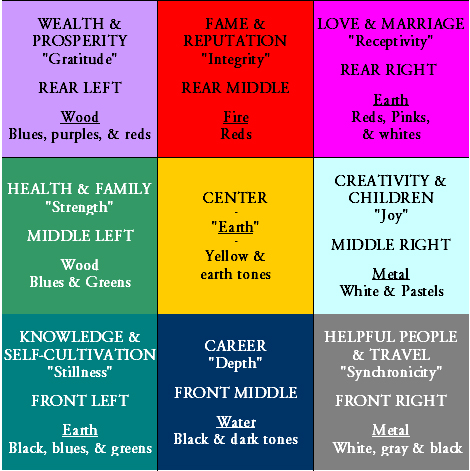
3. Define the Ba-Gua, or the feng shui energy map of your house, by using one of the two main feng shui methods – the compass or the BTB grid. Once you define the bagua, you will know which areas of your home are connected to specific areas of your life. For example, in traditional feng shui, the Southeast feng shui area of your home is connected to the flow of money energy in your life.
4. Study the Five Elements Feng Shui Theory to help you balance the feng shui five elements in your home, as well as strengthen specific elements in specific feng shui areas. For example, if you are working on attracting more prosperity, you will introduce the feng shui elements of Wood and Water in the Southeast area of your home.
5. Know Your Feng Shui Birth Element and create a home to support your personal feng shui element. For example, if your own element is Fire, you need to introduce the expressions of Fire feng shui element, such as the Fire element colors(red, orange, purple, magenta, pink, yellow), triangular shapes, etc.
You will also need a strong Wood element in your home, as Wood feeds the Fire in the relationship of five feng shui elements.
6. Know Your Kua Number and position yourself so that you benefit throughout the day from your best, or lucky feng shui directions. Adjust the position of your bed, your desk, the seating in your dining area, etc. For example, if your Kua number is 1, it is best to face one of the following directions: Southeast, East, South, and North.
7. Always Be Mindful of the State of Your Home and how the energy in your home influences your well-being. Make a habit of paying close attention to the so-called feng shui “triangle” that is deeply connected to your health – your bedroom, your bathroom and your kitchen. Nothing is static in the world of energy, so be wise and keep your home healthy and happy.
After you have mastered the seven home feng shui steps, you can explore the deeper levels of feng shui, such as, for example, the flying star school of feng shui. Be sure to start with the basic steps, though, before applying complex feng shui formulas.
Image: Pixabay
See EXCLUSIVE In5D videos and ad free articles on Patreon for a minimal donation! https://www.patreon.com/in5d
Follow In5D on Patreon, Telegram, Twitter, Bitchute, TikTok, Instagram, Facebook, YouTube, Gab, and Truth Social @greggprescott