



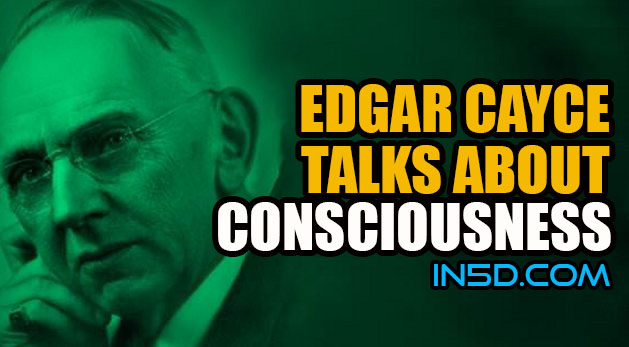
Edgar Cayce Talks About Consciousness

by Kevin Williams
This source of answers to the mysteries of life has no unifying name for its body of knowledge. Various parts of its principal concepts are actually scattered throughout different cultures and countries with no central collection point for the ideas. Because of this, and because many of its ideas are not widely known (often the adherents of these ideas have purposefully withheld them from the public), this school of thought can be referred to as the “secret teachings.” But it is not a single school of thought; rather, it’s a hodgepodge of concepts from many diverse and often unrelated sources that reveal a very similar view of life and its meaning.
Donate to In5D
With over 6,000+ free articles and 1,200+ free videos, any donation would be greatly appreciated!
Much love for your kind donation,
Gregg
The Beginning of Consciousness
Science might categorize the secret teachings as metaphysical, meaning “beyond the known laws and observations of physics.” Religion might refer to them as mystical, meaning that they belong to a collection of thought considered too mysterious to consider or of dubious origin.
It’s interesting to note that the great religions had sects that knew of and ascribed to some or all of the secret teachings. In Islam it was the Sufis; in Judaism, the Kabbalists; in early Christianity, the Gnostics and later, from the Middle Ages through the Reformation to even modern times, the many Christian mystics.
Science, too, has had its adherents to concepts held by the secret teachings. Many quantum physicists have written about theories of life beyond the physically observable. In the field of medicine, doctors have found that some patients, who have been declared dead and later revived have had near-death experiences that confirm many of the concepts found in the secret teachings.
According to the secret teachings, the universe was not first created out of matter, but existed prior to material creation in spirit form. Imagine a consciousness similar to our own, except that this first consciousness was boundless, a Universal Consciousness. This is God. At some point, the Universal Consciousness desired to express itself. It began to conceive, to imagine, and to express Its inner promptings. And so the creation began – light, sound … eventually stars, galaxies, trees, and rivers. This point in creation was still prior to the physical creation of the universe that science records. This was a realm of thought; no physical forms existed, only thoughts in the consciousness of the Universe. The physical universe had not yet been created.
According to the secret teachings, there came a point in this creation where the Creator’s Consciousness desired to bring forth companions, creatures like unto Itself that would share in this expression of life. In order for the creatures to be more than creations, they had to possess individual consciousness and freedom so that they could choose to be companions. Otherwise, they would only have been servants of the Original Consciousness. So within the One Universal Consciousness many individual points of consciousness were awakened and given freedom.
It’s important for us to realize that at this point in our existence we did not have physical bodies. All of what has just been described occurred within the Mind of God. Consequently, its “form” resembled that of thought rather than physical objects. In the very beginning we were individual points of consciousness within the one great Universal Consciousness.
At first we were quiet, our wills content to observe the wonders of the spiritual creation as they flowed from the Mind of God. In these early periods we were so much a part of the Creator’s Consciousness that we were one with It, virtually indistinguishable from It. However, it wasn’t long before some of us began to use our wills and express ourselves. At first, we simply imitated the Creator, but eventually we gained experience, and with experience came knowledge and confidence. Then, we truly began to create on our own, adding new realms to the spiritual creation, much like a second voice adds to a song by singing harmony with the main melody.
This was exactly why we had been created – to share in and contribute to the great expression of life and to be Its companions. To fulfill this purpose we were created in the image of the Creator: consciousness with freedom, capable of conceiving, perceiving, and remembering; capable of communicating directly with the Creator and the other companions.
Consciousness and free will were the greatest qualities given any creation, but they came with equally great responsibility for their use or misuse. Of course, the all-knowing Universal One knew the potential dangers in giving beings complete freedom to do as they desired. However, the potential joy of sharing life with true companions, not servants, was deemed worth the risk. Therefore, each of these new free-willed beings would simply have to learn to take charge of themselves and to subdue harmful desires in order to live in harmony with the other companions and the Creator. To do otherwise would only bring chaos, suffering, and separation.
Unfortunately, chaos came. As we continued to use our godly powers, w became more fascinated with them. We began to focus more and more on our own creations and became less concerned with and attentive to their harmony with the Creator, with the Whole. The more we thought of just ourselves and our own desires with less regard for the Whole, the more self-centered we became, eventually perceiving ourselves as separate from the Whole.
Of course, this sense of separation was all in our minds, so to speak, because there really was no way we could exist outside of the Whole because everything was of spirit. It was more a result of our sustained focus of attention on ourselves and our self-interests that resulted in a heightened sense of a distinct and separate self.
This was the beginning of trouble. It led to a very long fall for us. A fall that eventually left us feeling alone and separated from the rest of life, even to the point that we, who were actually companions and co-creators with the Universal Creator, today come to think of ourselves as little more than dust-like creatures, descendants of apes and inhabitants of a planet on the outskirts of a typical galaxy in the endless and diverse universe.
This chaos occurred in spirit when no physical universe existed. To know ourselves and yet be one with the Whole was the ideal condition, but the centering of awareness on self alone resulted in a sense of separation from the Whole. The more we exercised our individual consciousness and free will for self-interest, self-gratification, self-glorification, and self-consciousness, the more we heightened our sense of self apart from the Whole.
The resulting loss of contact with the Source of our life and the purpose of our existence was the beginning of darkness and evil, which is ignorance. Without a clear sense of our relationship to the rest of life, many of us began to use free will in ways that were never meant to be. Others simply let themselves be carried along with the current of life, abdicating their free will to the will of others. In both cases, these were things that would make it very difficult for us to be companions to the Creator.
However, the Creator foresaw this potential and, prior to creating companions, It created a Universal Law: Whatever one did with its free will, it must experience the consequences. The law was not intended as punishment or retribution for offenses, but as a tool for education and enlightenment. Thus, as we used our freedom, we experienced the effects. In this we came to understand and learn.
Interestingly, both science and religion recognize this law. In science it is often stated, “For every action there is an equal and opposing reaction.” Its religious counterparts are, “An eye for an eye, a tooth for a tooth”; “As you sow, so shall you reap”; and “As you do unto others, it will be done unto you.” Even today’s common knowledge expresses this principle in the saying, “What goes around, comes around.”
This is the law of karma, of cause and effect. It was, and is, the great teacher of the companions-to-be and it is an integral part of the secret teachings. Once this law was established, the Creator conceived and freed countless independent points of consciousness within Its own infinite consciousness and the companions came into being, each conscious and free. What a trembling wonder it must have been in those first moments!
Again, it’s important to realize that the companions were not physical bodies. They were like “ideas” in the mind of the Creator that were given freedom to be independently conscious. As they used their freedom, they developed into unique points of thought, feeling, desire, expression, and memory. Each was slightly different from the other by virtue of its different vantage point within the Universal Consciousness. Each companion had a spirit, mind, and a soul. Spirit is the essence of life. Remember the condition of the Creator before the creation; alive yet still. This is Spirit. It is the living stillness in the midst of activity. So often we identify life with motion, but the essence of life was there before the motion. Spirit is the essence of life.
Life in motion, or the power to move and shape ideas and even physical forms out of spirit, is mind. Mind is the sculptor, the builder who conceives, imagines, and shapes ideas out of the essence of life. Spirit is life; Mind is the power to use it.
Each of the companions had spirit and mind. As they used their life forces, they developed experiences, memories, desires, fears, etc. This caused them to become unique from one another – each having its own collection of experiences and aspirations; each its own story. This individual aspect of the companion is its soul. Soul is the sum total of all that the companion had done with its free-will consciousness. It’s the companion’s story, its complex of memories. All of the companions have spirit and mind, but each developed a unique soul, because each built a different collection of memories and experiences, resulting in different desires, hopes, and attitudes about life. Thus, spirit is the life force, mind is the power to use it, and soul is the being that develops. All are one in consciousness.
The Division of Consciousness
The creation then progressed from essence to thought, thought into thought-form, and from thought-form into particle-form or atomic-form; in other words, matter. There are many realms to life. One of these realms is the third dimension – physical form, as we know it today.
The companions, filled with their newfound consciousness and freedom, went out into the vast universe to experience life and to learn about themselves, the Creator, and their relationship to it. In their travels through the cosmos, some of the companions entered the three-dimensional influences of the planet Earth where they entered into physical form for the first time. Here they became so encapsulated in the physical that they began to identify themselves more with their form than with their consciousness. They began to think of themselves as physical entities rather than free, living consciousness. Incredibly, they began to think they were only terrestrial beings and their celestial origins began to be forgotten. Form was so substantial, so captivating that it was difficult to hold on to the more delicate reality of spirit-thoughts, pure point of consciousness in a Universal Consciousness.
To have an individual body was also the ultimate in self-identity and self-expression. It then had the power to separate the individual from the Whole and the formless spirit-thoughts of higher realms.
Strong identification with the physical made the companions subject to the laws of nature, and, of course, a part of nature’s cycle is death. The body would come to life according to the laws of nature, live for a time, and then die. In their original state, the companions were continually alive, but those that began to strongly identify with their physical bodies were now affected by death. Since they thought they were their bodies, they considered themselves dead when their bodies died.
This led to great confusion, and when the companions who had not become involved in the material universe saw what had happened to the others, they decided to help those in the flesh regain their former state. However, it was not going to be easy.
In addition to the influences of the physical dimension, the souls were building reaction patterns (karmic patterns) with their willful activities in the physical universe. According to Universal Law, these actions had to be met – properly met in the physical universe where they had been initiated. The more one acted in the physical dimension, the more one built debts that had to be met in the physical. Death changed nothing except those with karmic debts to be paid had to pay them by incarnating into another physical body. The result of this was reincarnation.
Another effect of entering the physical dimension was the division of consciousness. According to the secret teachings, as an individual entered deeper into the physical, its consciousness separated into three divisions of awareness. Two of these divisions we acknowledge today: the conscious and subconscious. The first entails the physical realm where the human body required a three-dimensional consciousness to function. It has become the part of our consciousness we are most familiar with, what we have come to call the conscious mind. Many of us would consider it to actually be the “I” or “me” of ourselves. It is within this part of consciousness that we experience physical life, and our personalities are developed.
The second part of consciousness is shadow-like while one is incarnate in the physical dimension. It lives life as a shadow, always there, listening, watching, remembering, and only occasionally making its profound and sometimes frightening presence known. We have come to call this part of our consciousness the subconscious mind. From out of this area come dreams, intuitions, unseen motivations, and deepest memories.
According to many teachings, the subconscious is the realm of the soul that uses the conscious mind as a mechanism for manifesting in the physical realm through the five senses. Often the thoughts and interests of the conscious mind, combined with the desires of the body, become so strong and dominant that only its activities seem important and real; the subconscious seems illusionary and unrelated to outer life. But in truth, the real life is occurring in the subconscious.
The third area of the now divided consciousness is the most universal. It is the part we can perceive and commune with the Universal Consciousness. We have different names for it: the Collective Mind, the Universal Mind, the Collective Unconsciousness, and the superconsciousness.
The more one’s attention moves into the conscious mind, the more narrow and limited the focus and awareness becomes. The more one moves toward the superconsciousness, the more one becomes aware of the Whole, the Universal Forces, the Creator.
It may be more difficult to perceive the infinite when one is grossly involved in the finite, but the Universal Consciousness and the potential for attuning oneself to It remains. Curiously, access to it is through the inner consciousness of the incarnate individual and not outside of it, making it a very mysterious passage for a physical being.
In time, however, the companions trapped in the physical dimension could again become aware of the difference between terrestrial and celestial life. They could again come to know their original state and purpose, and regain their celestial birthright of companionship with the Creator. In time they could again come to realize that the conditions in their present physical life were the result of their free-will actions and choices before the present life.
If the companions trapped in the physical dimension could genuinely begin to believe that the physical cannot possibly be all there is to life, they could begin the long journey back from form to spirit, a very difficult journey. In many ways we, as human beings, are no longer spirit. Flesh has become very much a part of us, not just physically but mentally as well. Even when we are out of the body (through death, deep sleep, or some altered state such as meditation), bodily manifestation is still very much a part of us. Otherwise, there would certainly be no reincarnation. We would simply leave the physical dimension and never return.
The great paradox of humankind is that we are now both spirit and flesh. That’s like saying we are a combination of oil and water, two substances which do not combine. The mystical analogy would more properly be fire and water; these, too, don’t combine. How can anything be made up of two substances that are impossible to combine? Yet, such is the nature of humanity. We are constantly forced to reconcile the seemingly irreconcilable: mercy with justice, cooperation with independence, unity with diversity, tradition with change, feeling with thought, love with truth, and on and on.
The Consequences of the Division

In order to fully appreciate the secret teachings, we need to understand how the Universal Law of cause and effect works. It’s easy to say that the experiences in one’s life are the result of past activities, but the forces of this law are greater than we may first imagine.
Every action, every thought, every idle word sets up reactions, according to the Universal Law. When one thinks a thought, that thought makes an impression on the Universal Consciousness. Nothing is lost or done in secret. Everything is done within the Universal Consciousness, and the Whole is affected by it (as well as all others within the Whole).
This isn’t easy for us to believe, living in our own little worlds. The words “secret”, “private”, “alone”, and “separate” are active words in our vocabulary. This is due to our current separation in consciousness from the Whole. In the higher realms of consciousness, there is no space. Things and people are not separate, but part of a Whole. All is actually One. All is within the Whole. By increasing the focus on self, we have created the illusion of a self separated from the rest of life, but it just isn’t so. Our individual actions and thoughts make an impact on the Mind of the Universal One (the Whole).
Thoughts are things. Thoughts are real.
Reactions to past thoughts and actions become our fate, destiny, and karma. An individual’s fate is simply the rebounding effects of previous choices remembered by its soul. The reason the effects of these previous choices often seem unfair to the conscious mind is because the personality doesn’t see beyond its own life for sources of current conditions.
As companions of God, we are free to live and choose and grow almost as we desire, but not without being subject to the Universal, Spiritual law. Through meeting our thoughts, actions, and words we learn to discern wisdom from folly, lasting strength from weakness, and true life from illusion. In turn we become more able to fulfill our ultimate purpose for existing: to be a companion to the Universal Creator. The law is actually a magnificent tool for perfect learning. It is completely impersonal – everyone experiences it equally and for the purpose of enlightenment.
The law of karma is not some fierce god in the sky keeping track of everything so that it can zap people when they least expect it. Most karmic reactions, in fact, come from the individual’s own deep memory of what it has done.
Karma has been described as memory. Karma is memory coming to consciousness again. What has occurred in the past is recalled and has an effect on the present. Now, the recollection may not surface to the conscious level; the personality may have no awareness of the memory, in fact. Yet, it exists at the deeper, soul level. Nevertheless, the soul sees through the same eyes as the personality and is reminded of its past use of free will and consciousness. Naturally, some of these memories will be compatible with the Universal Mind and some will not. Memory is an important concept in understanding how the law of karma works.
As a soul draws closer to the Universal Mind, it becomes aware that some of its memories are not compatible with the Creator, and since its ultimate purpose for being is companionship with the Creator, it seeks out opportunities to resolve these incompatible memories.
Suppose a soul criticizes another soul among its peers and behind its back. As it becomes more aware of its true nature, it will recall this wrong and, because of its incompatibility with the Creator, will seek to correct it. Now, the resolution could take many forms. The soul might seek out an opportunity to work closely with the injured soul as a supporter, assistant, publicist, agent, or the like. Or perhaps it would seek to re-create the original scene – putting itself in a position to criticize the other soul again in front of the same peers. The test would be to see if the soul would choose not to criticize this time, even if it meant a certain loss of position for itself. Throughout all this the soul grows wiser and more compatible with the Creator.
If, however, a soul has gotten so far away from its true nature that it has no conscience, then the law of karma can become a formidable obstacle to any further free-will action. Such a soul becomes surrounded by its karma; everywhere it turns, it meets the terrible effects of its previous action and thoughts. Yet, even a soul who has gotten in this pathetic situation can return to perfection because there is no total condemnation from the Creator or the law. If the soul turns away from its self-centeredness and begins acting, reacting, thinking, and speaking like a companion to the Universe, then the law is just as perfect as it is with error; and the reactions begin to build and establish a new destiny for that soul.
Karma is memory. As one recalls or relives situations, one meets self again, and a new decision point, or crossroads, is presented to the soul. In life, “good” would be equated with compatible, harmonious actions and thoughts which consider the needs and desires of others, along with self’s needs and desires. “Evil” would be equated with actions and thoughts that are motivated by a self-orientation that pays little or no attention to the needs and desires of others and the Whole. Metaphysically speaking, good results in oneness, and evil results in a sense of separation. Decisions in one’s life could be approached by evaluating which choices promote greater oneness and which promote separation.

One must meet every bit of one’s karma. However, there is a way that it can be modified, softened, even ameliorated. If a soul, knowing another soul has wronged it, forgives that soul and holds no lingering resentment – perhaps has even forgotten the wrong in the depths of its forgiveness and understanding – then it begins to take hold of the power of forgiveness. The more it forgives, the more it perceives an understands forgiveness. Then, when it approaches the Universal Consciousness and realizes it possesses memories that are incompatible with It, forgiveness is much more viable, removing the barrier of separation. The law is so precise (what one gives one receives; no exceptions) that if one begins having mercy on and forgiveness of others, one begins to receive mercy and forgiveness upon oneself. Unless, of course, one refuses to forgive oneself.
All of one’s karma has to be met. And yet, no soul is given more than it can bear to carry – this is the paradoxical blessing hidden in the limitations of time and space. A soul is given the time it needs to turn away from its selfish ways and, like the prodigal son, return home to a feast of joy and welcome from our Creator. Reincarnation is not a way to avoid judgment and responsibility; it is a way to allow the soul enough time to correct its mistakes and develop itself.
“All you may know of heaven or hell is within your own self.” – Edgar Cayce
source: www.near-death.com/experiences/cayce04.html
Image: Pixabay
See EXCLUSIVE In5D videos and ad free articles on Patreon for a minimal donation! https://www.patreon.com/in5d
Follow In5D on Patreon, Telegram, Twitter, Bitchute, TikTok, Instagram, Facebook, YouTube, Gab, and Truth Social @greggprescott